

Key Takeaways
- Franchising can accelerate business growth without opening every location yourself.
- Before franchising your business, ensure your model is profitable and easily replicated.
- Strong systems, training, and operational manuals are the foundation of a successful franchise.
- Legal compliance and protecting your intellectual property are essential.
- Recruiting the right franchise partners is more important than selling as many franchises as possible.
- Ongoing support helps franchisees succeed while strengthening your brand.
- A carefully planned franchise strategy creates long-term sustainable growth.
Introduction
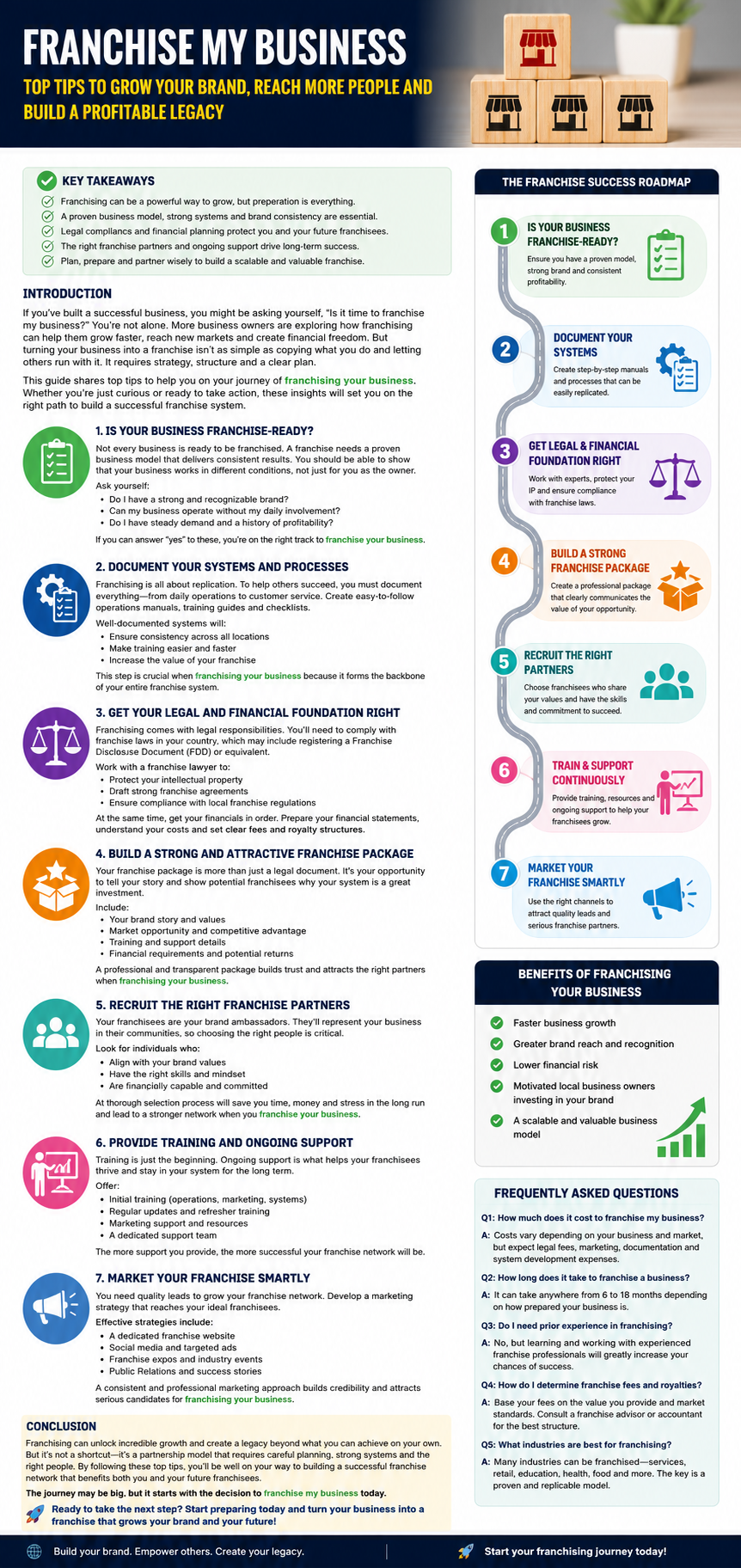
Many business owners eventually reach a point where they ask themselves, “Should I franchise my business?” If you’ve built a profitable company with repeatable systems and a recognised brand, expanding through franchising could be one of the smartest decisions you ever make.
Whether you’re considering franchising my business for the first time or actively researching how to franchise your business, understanding the process is essential. Success doesn’t happen by chance—it comes from planning, documentation, legal compliance, and selecting the right franchise partners.
This guide explains everything you need to know before taking the next step.
1. Is Your Business Ready for Franchising?
Before franchising your business, take an honest look at whether your business model can be replicated successfully.
Ask yourself:
- Is the business consistently profitable?
- Does it operate using documented systems?
- Can someone else follow those systems successfully?
- Is there strong customer demand?
- Does the business have a recognised brand?
A franchise should deliver consistent customer experiences regardless of location. If every outlet depends entirely on the owner’s personal involvement, additional preparation may be needed before you franchise your business.
2. Build Systems That Can Be Repeated
One of the biggest reasons franchises succeed is consistency.
Every aspect of the business should be documented, including:
- Daily operations
- Customer service standards
- Sales processes
- Staff recruitment
- Marketing procedures
- Health and safety
- Financial reporting
When franchising your business, these documented systems become your Franchise Operations Manual.
The easier your systems are to follow, the easier it becomes for franchisees to replicate your success.
3. Protect Your Brand
Your brand is one of your most valuable assets.
Before you franchise your business, ensure you have protected:
- Business name
- Logo
- Trademark
- Website
- Marketing materials
- Intellectual property
Strong branding creates confidence among prospective franchisees while protecting your competitive advantage.
4. Understand the Legal Requirements
Every franchise should have professionally prepared legal documentation.
Typically this includes:
- Franchise Agreement
- Operations Manual
- Disclosure documentation (where required)
- Confidentiality agreements
- Intellectual property licences
Attempting franchising my business without experienced franchise lawyers can create unnecessary legal risks.
Professional advice protects both you and future franchisees.
5. Create an Attractive Franchise Package
Potential franchisees aren’t simply buying a business.
They’re investing in:
- A proven system
- A recognised brand
- Training
- Ongoing support
- Marketing
- Business coaching
A professional franchise package should clearly explain:
- Initial investment
- Training programme
- Ongoing fees
- Marketing support
- Territory information
- Expected responsibilities
The stronger your package, the easier it becomes to attract high-quality franchise partners.
6. Recruit the Right Franchisees
Not every applicant is suitable.
The best franchisees are:
- Motivated
- Financially stable
- Customer-focused
- Good communicators
- Willing to follow systems
- Passionate about the brand
When franchising your business, selecting quality partners is far more important than growing quickly.
Strong franchisees help build your reputation.
Poor franchisees damage it.
7. Deliver Outstanding Training
Training should cover far more than operating equipment.
Include:
- Business operations
- Customer service
- Sales
- Marketing
- Technology
- Recruitment
- Financial management
- Brand standards
Comprehensive onboarding gives franchisees confidence from day one.
Businesses that invest heavily in training usually enjoy stronger long-term franchise performance.
8. Support Your Franchise Network
Your relationship with franchisees doesn’t end after launch.
Successful franchisors provide:
- Business coaching
- Marketing support
- Software updates
- Performance reviews
- Site visits
- Refresher training
- New product guidance
Supporting franchisees helps maintain consistency across every location.
This is one of the biggest differences between successful and struggling franchise systems.
9. Market Your Franchise Opportunity
If you’re asking, “How do I attract people interested in franchising my business?”, marketing is essential.
Consider:
- Franchise exhibitions
- Franchise portals
- SEO
- PPC advertising
- LinkedIn campaigns
- Industry publications
- PR campaigns
- Success stories
- Video testimonials
People don’t simply buy businesses—they buy confidence.
Strong marketing demonstrates why your franchise opportunity is worth investing in.
10. Think Long-Term
Many people believe franchising your business is a quick route to rapid growth.
In reality, successful franchises focus on sustainable expansion.
Avoid selling too many franchises too quickly.
Instead:
- Recruit carefully.
- Protect your brand.
- Maintain standards.
- Invest in support.
- Continue improving your systems.
Long-term thinking builds stronger franchise networks and greater profitability.
Common Mistakes to Avoid
Many businesses struggle because they:
- Franchise before proving profitability.
- Fail to document systems.
- Recruit unsuitable franchisees.
- Underestimate legal requirements.
- Provide poor training.
- Offer limited support.
- Expand too quickly.
Avoiding these mistakes significantly improves your chances of long-term success.
Conclusion
If you’ve been wondering whether it’s time to franchise my business, the answer depends on preparation rather than ambition alone.
Businesses that invest in systems, legal protection, training, marketing, and ongoing franchise support are far more likely to build thriving national—or even international—franchise networks.
Whether you’re just beginning to explore franchising your business or you’re actively preparing to franchise your business, taking the time to create a scalable model will pay dividends for years to come.
Franchising is more than expansion—it’s about creating a business that others can successfully replicate while protecting the quality and reputation you’ve worked so hard to build.
Book a FREE consultation with a Franchise UK approved expert, complete the form below;